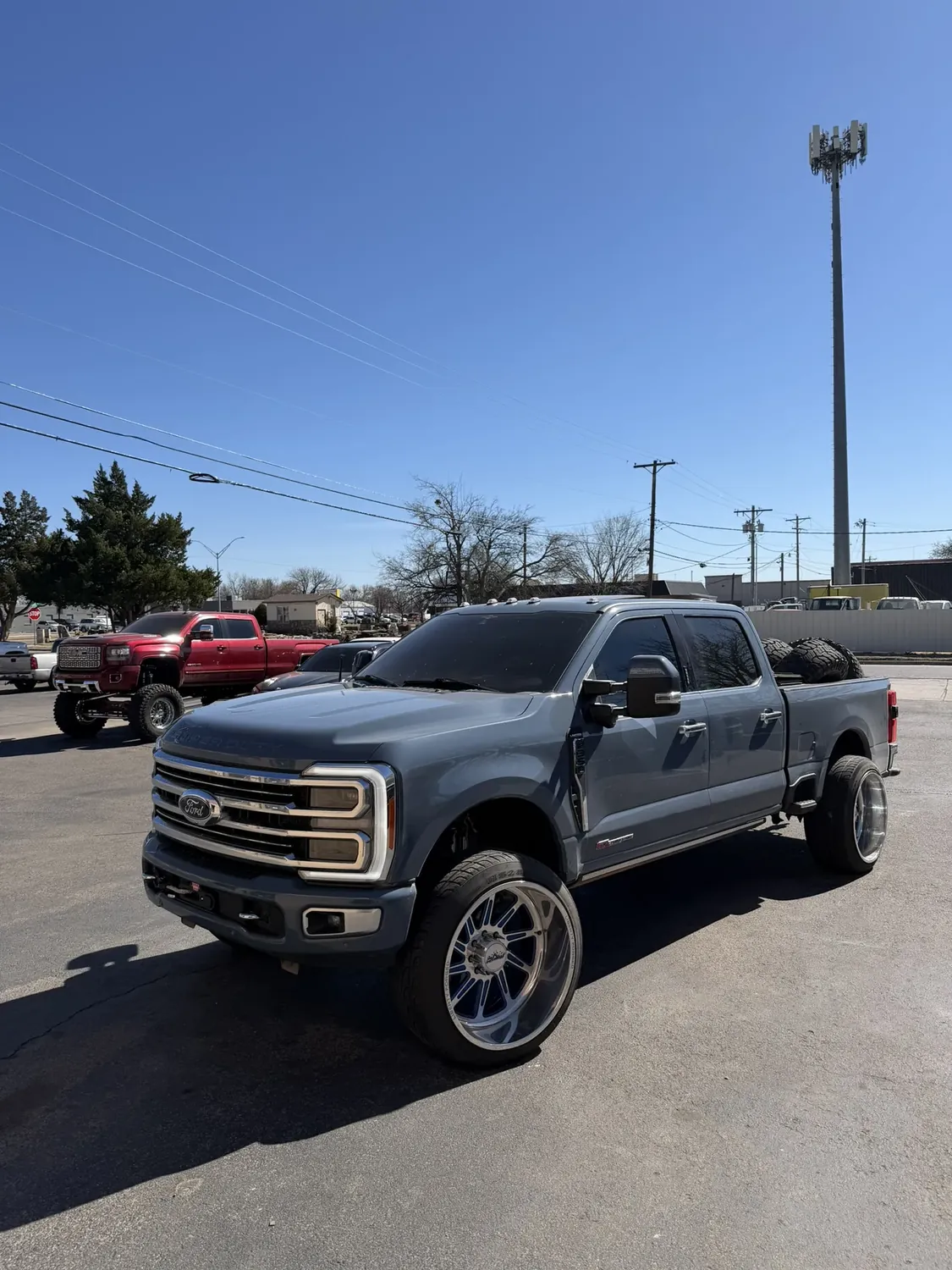
Wheel fitment is the part of a build people underestimate the most. A wheel is not just a diameter and a width. The number that decides whether it tucks clean, sits flush, or pokes out past the fender is offset, and its cousin backspacing. Get those wrong and you are looking at rubbing, fender liner damage, worn ball joints, or a truck that fails an alignment.
We spec wheels and tires in-house on every build for exactly this reason. Here is the plain-English version of what we are thinking about.
What Offset Actually Is
Offset is the distance between the wheel's mounting face (the flat part that bolts to the hub) and the true centerline of the wheel. It is measured in millimeters.
Positive Offset
The mounting face sits toward the front (street side) of the wheel. The wheel tucks in toward the truck. Most factory trucks run a mild positive offset. Nothing pokes, everything sits under the fender.
Zero Offset
The mounting face is exactly on centerline. The wheel sits a little further out than stock.
Negative Offset
The mounting face sits toward the back (brake side). The wheel pushes out away from the truck. This is the aggressive "deep lip" look. The more negative you go (-12, -24, -44, -76), the more the tire moves out past the fender. That is "poke," and it is a look a lot of people want. It also has consequences.
Backspacing Is the Same Idea From the Other Side
Backspacing is the distance from the mounting face to the back lip of the wheel. Offset and backspacing describe the same geometry. If you know the wheel width and one number, you can calculate the other. Shops and manufacturers tend to talk in offset. Old-school fabricators and a lot of tire guys still talk in backspacing. Less backspacing means the tire moves outboard, toward the fender edge and beyond.
What Changes When You Push the Wheel Out
Going more negative on offset does more than change the stance.
Rubbing and Clearance
The tire moves closer to the fender and the fender liner. On a lifted truck at full steering lock and full suspension compression, like taking a driveway apron or a dip at speed, that is where contact shows up. Sometimes it is a trim job on the liner. Sometimes it means a different wheel.
Scrub Radius and Steering Feel
Pushing the wheel outboard increases scrub radius. The truck can feel twitchy over rain grooves, tramline more, and fight you a little under hard braking. It also loads the steering components harder.
Wheel Bearings and Ball Joints
Every millimeter you move the tire away from the hub adds leverage on the wheel bearing and front end. A big negative-offset setup on a heavy truck wears bearings, unit hubs, and ball joints faster. That is not a reason to never do it. It is a reason to know it going in.
Lift, Tire Size, and Fitment All Talk to Each Other
You cannot pick a wheel in isolation. A leveling kit, a mid-travel lift, and a 10-inch lift each open up a different amount of room, and each one changes where the tire contacts at articulation. Move up from a 33 to a 35 to a 37 and the fitment window shifts again. Wider tires need attention to both the inboard side (control arm, sway bar end link, coilover) and the outboard side (fender).
This is why we do not just order what is on the box art. We look at the specific truck, the lift, the tire you want, and how you drive it, whether that is a daily, a tow rig, a trail truck, or a show truck. Then we spec a wheel that fits all of it.
Common Questions
Can I run a spacer instead of buying the right wheel?
A quality hub-centric spacer, properly torqued, has its place. It is usually a small correction. Stacking big spacers to fake an aggressive offset is not something we like to do on a customer truck. It adds another failure point and more bearing load.
Will aggressive wheels fail an alignment?
The alignment itself still sets toe, camber, and caster. But an extreme setup can put you at the edge of adjustment range and makes any worn component show up faster. We check the front end before we commit to a fitment.
What is the "safe" aggressive offset for a lifted truck?
There is no single number. It depends on the platform, lift, and tire. On a lot of modern half-tons and three-quarter-tons, something in the -12 to -24 range with the right tire clears with minor liner trimming. Going past that starts asking for fender work. We will tell you where your specific truck lands.
Bring Us the Whole Picture
If you are shopping wheels, talk to us before you buy. Tell us the truck, the lift you have or want, the tire size you are after, and the look you are going for. We will spec a package that bolts up, clears, and holds up. Then we mount, balance, and torque it in-house.